Reading room / Article
The 1940s Explained: Wartime Life, Clothing, and Photography
The 1940s were shaped by the Second World War and its aftermath, but “wartime style” is not a universal costume. Uniforms, rationing, women’s paid work, displacement, propaganda, mourning, and post-war rebuilding affected people differently across continents and social groups.
Dates, geography, and the war’s unequal reach
The decade runs from 1940 to 1949; the Second World War lasted from 1939 to 1945. Its theatres reached Europe, North Africa, the Atlantic, Asia, and the Pacific, with colonial troops and civilians deeply involved. Occupation, genocide, forced labour, incarceration, bombing, and displacement make this a period that requires precise language and care.
After 1945, demobilisation, housing shortages, rationing, reconstruction, independence movements, and new international institutions shaped everyday life. A US home-front image, a British ration book, a South Asian independence photograph, and a European displaced-person portrait belong to different histories.
Utility, uniform, and the limits of the silhouette
Wartime restrictions encouraged economical use of cloth, simpler cuts, and practical separates in many countries. Women entered or expanded roles in factories, transport, agriculture, offices, nursing, and military auxiliary services, while uniforms created distinct visual identities. Men’s civilian dress continued alongside service uniforms and workwear.
Victory rolls, scarves, waved hair, short practical styles, and brimmed hats are associated with the era, but hair depended on work, resources, culture, and personal choice. The post-war New Look and local dress traditions further complicate any single “1940s look.”
Photography between record and morale
Press, government, military, studio, and family photographs served different purposes. A formal service portrait could be a keepsake; a news image could inform or persuade; a small snapshot could maintain intimacy across separation. Censorship and propaganda affected what was made public.
Look for photographer, commissioning body, caption, date, negative or print type, and provenance. The fact that a photograph is black and white, grainy, or damaged does not establish that it was made during the war. Archives preserve both the image and the context needed to interpret it.
Do not turn trauma into a costume
A “wartime” label can inadvertently make occupation, persecution, combat, and civilian loss look like decorative themes. Describe the specific region and experience when known, and do not invent military service, evacuation, or resistance histories for an unidentified person.
The Imperial War Museums, United States Holocaust Memorial Museum, and national archives provide stronger starting points than generic nostalgia. Their records also demonstrate why a single fashionable image cannot represent the decade.
My Other Era’s restrained wartime-era option
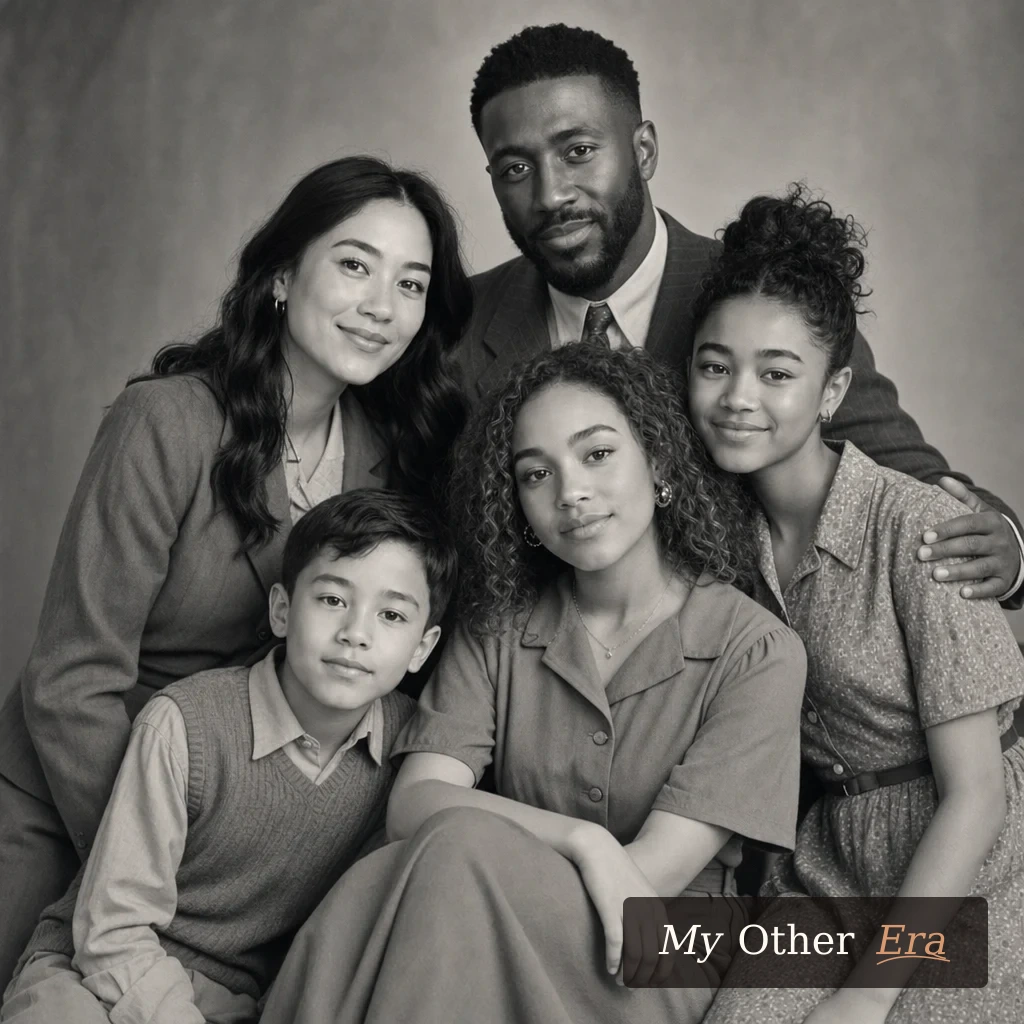
My Other Era’s 1940s treatment draws on practical tailoring, modest composition, and mid-century studio cues. It is a respectful, broad creative interpretation—not a depiction of battle, a claim of service, a reconstruction of a uniform, or an archival photograph.
Select an original photo with a visible face and shoulders and decide what story you actually know. If the original photo has a service record, caption, or family testimony, keep that information with the original rather than letting the generated styling supply facts.
Continue through the post-war decades
The 1950s guide follows the rebuilding decade’s polished portrait conventions. For a visual timeline rather than one era, see portrait photography through the decades.
Every era button in the studio is a style choice. It does not alter a current generation or turn a creative result into a historical document.
Try the studio
Try a 1940s-inspired portrait
The treatment references civilian and studio style cues; it does not portray combat, service, or a specific wartime event.
Open the studioRelated reading
Sources and further reading
AI-assisted draft, fact-checked against the sources below and reviewed by the My Other Era editorial team. No individual reviewer is named because no individual reviewer is being claimed.