Reading room / Article
Portrait Photography Through the Decades: A Visual Timeline
Portrait photography changed as cameras, exposures, film, flash, studios, and consumer formats changed—but technology is only part of the story. A portrait also reflects who could afford it, where it was made, what the occasion was, and how subjects were expected to pose. This timeline is a practical visual vocabulary for reading those shifts from the late nineteenth century to the early 2000s.
Late nineteenth century: the formal studio
Long exposures and the cost of early photographic materials encouraged still, deliberate posing. Painted backdrops, studio furniture, carefully arranged clothing, and controlled light helped make a portrait feel like a public presentation. The result was not simply “Victorian style”: practices differed across Britain, Europe, North America, and other regions, and a formal studio portrait was not the same as everyday dress.
Small formats such as the carte de visite and cabinet card helped portraits circulate as objects. A mount, photographer's imprint, and studio setting can therefore be as informative as the face itself when examining an old photograph.
1900s–1910s: mobility and a changing public image
Improved cameras and photographic materials gradually broadened the kinds of images people could make, while studios remained important for formal portraits. Poses could still be composed, but the visual vocabulary expanded to include more natural expressions, outdoor settings, and photographs connected to work, travel, school, or military service.
Do not use a single hat or collar as a date stamp. Compare the whole image: border and mount, photographic process, clothing, hair, architecture, and the occasion suggested by the pose.
1920s: sharper modernity and expressive studio light
The 1920s are associated with modern graphic design, bobbed hair, and a greater willingness in some settings to use stronger angles and expressive poses. Professional portraiture could be polished and theatrical, while family and working photographs remained varied and often conventional. Art Deco influence is a useful visual reference, not a label for every image made during the decade.
Lighting, geometric backgrounds, and a direct gaze can suggest a modern studio portrait, but the same decade also contains soft family snapshots and practical outdoor photographs.
1930s: controlled light, affordability, and everyday variety
The 1930s brought a broad mix of studio formality, inexpensive prints, amateur cameras, and documentary photography. Portraits might use sculpted light and elegant drapery, or show people at home and outdoors in clothing shaped by economic circumstances. The Depression affected access and subject matter, but it did not produce one universal appearance.
Look for the relationship between pose and setting. A carefully lit head-and-shoulders portrait tells a different story from a casual family photograph, even when both were made in the same year.
1940s: war, work, and the family photograph
Wartime portraits include uniforms, identification photographs, workplace images, studio portraits sent to relatives, and ordinary family pictures. Paper shortages, mobility, and separation shaped what was photographed and kept. A uniform can offer a clue, but it should not be used to infer a precise date or service without supporting evidence.
Photographic conventions varied widely by country and civilian context. Read the setting, insignia, print format, and accompanying writing together rather than treating “wartime” as a complete identification.
1950s: the accessible family studio and colour
Postwar consumer culture helped make family snapshots and studio portraits part of ordinary life for many people, though access remained unequal. Bright colour, formal poses, home interiors, and polished studio lighting can all belong to the decade. Black-and-white does not rule the 1950s out, and colour alone does not date a photograph.
For a family portrait, note furniture, curtains, cars, grooming, and the print's edges as well as clothing. Those surrounding details often carry more dating information than a generic suit or dress.
1960s–1970s: from mod geometry to casual colour
The 1960s saw strong contrasts between tailored, graphic mod looks and many other forms of dress. The 1970s likewise included disco glamour, practical workwear, punk, bohemian styling, and regional variation. Portable cameras and colour film made informal photographs more common, but a formal studio portrait never disappeared.
The photograph's format and context matter. Flash, saturated colour, a roadside snapshot, and a studio backdrop may narrow a date range, but they do not identify a subculture on their own.
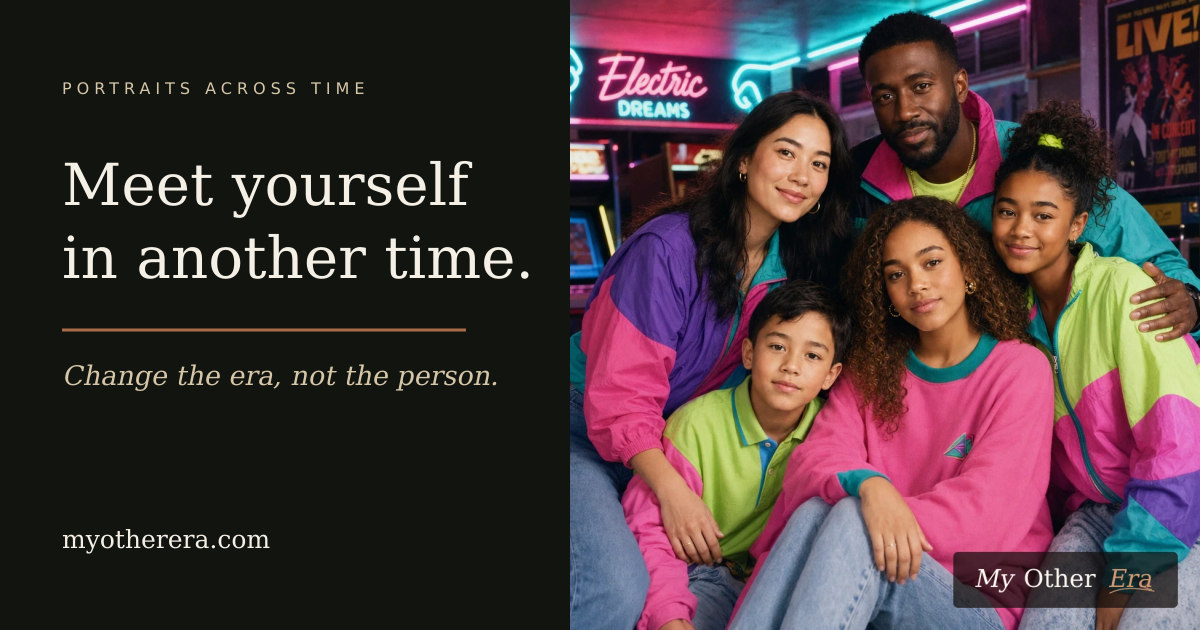
1980s–1990s: flash, identity, and the nightlife image
Consumer colour photography, on-camera flash, and changing music and fashion cultures shaped many late twentieth-century portraits. The 1980s could look corporate, new wave, athletic, punk, or domestic; the 1990s could look grunge, minimalist, club-oriented, or suburban. A glossy finish and direct flash are clues, not a complete aesthetic.
In both decades, ask who made the image and for what purpose. A disposable-camera snapshot and a professional editorial portrait may share a date but not a visual convention.
2000s: early digital and the searchable snapshot
Early digital cameras and camera phones introduced small sensors, built-in flash, visible noise, unusual white balance, and rapidly shareable images. These clues can be useful, especially with metadata or a known event, but later software can imitate them and older scans can distort them.
The early-digital look is therefore best treated as a combination of image evidence and provenance. Check the file, print, or original context when a precise date matters.
How to use the timeline for an era portrait
Choose the photographic behaviour you want—formal studio stillness, soft family light, direct flash, or a compact-camera snapshot—before adding wardrobe cues. Then compare the generated interpretation with real collections from the period. The goal is a coherent visual conversation with history, not a claim that one decade looked the same everywhere.
Frequently asked questions
Can photographic style date an image by itself?
Usually it can suggest a range, not a precise year. Combine photographic process, print or mount, clothing, setting, provenance, and any writing on the back. Later reproductions and digital edits can imitate an earlier look.
Why does the same decade have so many different portrait styles?
Photography depended on region, class, age, occasion, technology, and personal taste. A professional studio portrait, a school picture, and a holiday snapshot could all be made in the same year and look unrelated.
Try the studio
Explore an era in the studio
Use the timeline to choose a direction—formal, candid, softly lit, or flash-forward—then explore it with an original photo in the studio.
Open the studioRelated reading
Sources and further reading
- Victoria and Albert Museum: A History of Photography — Overview of photographic technologies and practices across periods.
- George Eastman Museum: Photographic Processes — Reference collection for understanding historical photographic processes and materials.
- Library of Congress: Prints and Photographs Online Catalog — A named primary-source photograph collection for comparing pose, setting, format, and catalogue context.
AI tools assisted with an early draft and copy editing. The My Other Era editorial team reviewed the text, checked the linked references, and remains responsible for the published version.