Reading room / Article
The 1950s Explained: Mid-Century Fashion and Portraits
The 1950s are often sold as one cheerful, polished suburban picture. In reality, post-war reconstruction, decolonisation, civil rights struggles, migration, television, consumer advertising, and Cold War politics produced very different experiences. This guide separates those histories from a deliberately polished portrait style.
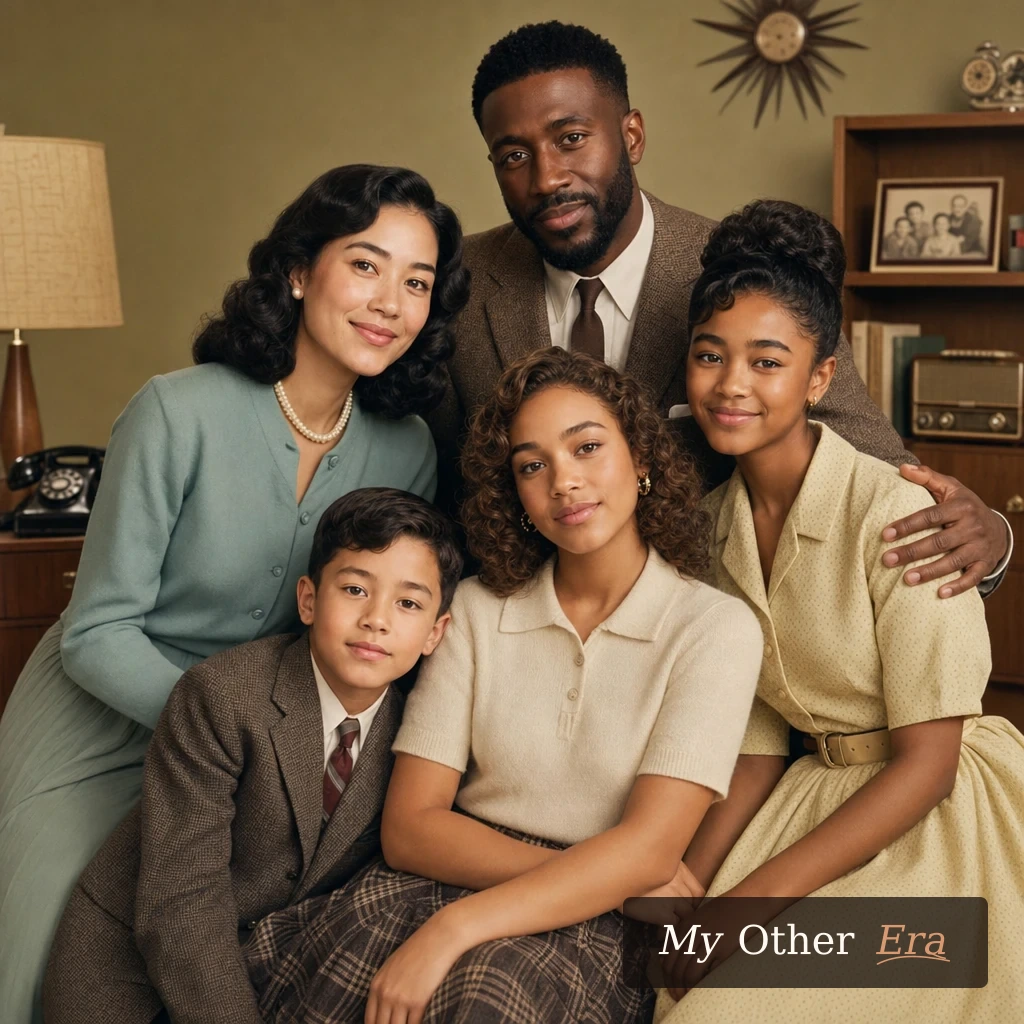
A decade of recovery and contradiction
The 1950s ran from 1950 to 1959, with post-war reconstruction and decolonisation transforming many regions. In the United States, economic expansion and mass consumption coexisted with segregation and racial violence; in Europe and elsewhere, housing, rationing, migration, and rebuilding followed local timelines.
Television, popular music, automobiles, supermarkets, and advertising expanded in some households. Access depended on income, race, gender, location, and national policy. The decade’s clean domestic image is a media construction as well as a record of some people’s lives.
New silhouettes and ordinary wardrobes
Women’s fashion included full skirts and nipped waists associated with the New Look, slim pencil skirts, tailored suits, knit separates, house dresses, and practical trousers. Men wore suits, sports jackets, shirts, workwear, and uniforms. Youth cultures and local makers often adapted mass-market trends rather than following a single runway shape.
Ponytails, rolled fringes, sculpted waves, short cuts, and headscarves appeared in different contexts. A polished hairstyle may indicate an occasion or studio preparation, not everyday grooming. Clothing and hair also reflect Black, Indigenous, immigrant, diasporic, and regional style histories that a generic “mid-century” label can conceal.
Portrait photography after the war
Family cameras, colour film, school portraits, commercial studios, photo booths, and television publicity all broadened the visual record. Flash photography made indoor snapshots easier, while studio lighting and retouching maintained a formal ideal for weddings, graduations, and professional portraits.
Colour is a useful clue but not a date stamp: colour processes existed earlier and monochrome remained common. Paper, border, camera format, clothing, setting, inscriptions, and family chronology provide better combined evidence than a nostalgic palette.
The people outside the postcard
The era included domestic labour, factory work, student activism, migration, disability advocacy, protest, and expanding or contested civil rights. “Traditional family” imagery was actively promoted by advertisers and governments, while many real households did not fit it.
When researching a person, name their country, community, occupation, and date where known. Museum collections at the Smithsonian and V&A can show material culture, but no collection can stand in for every 1950s experience.
My Other Era’s polished-50s interpretation
The polished-50s treatment borrows neat tailoring, friendly studio lighting, restrained colour, and mid-century occasionwear. It is not a promise to reproduce an exact garment, a claim that a sitter lived in a suburban household, or proof that the resulting image was made in the 1950s.
Choose a clean, well-lit original photo if you want a classic studio result. Keep modern context if it carries meaning: the studio can suggest a period mood without erasing the person’s actual identity or biography.
Read on
For the youth-led visual break that followed, read the 1960s and Mod fashion. For family-photo planning, see 1950s family portrait ideas.
Use the studio CTA for creative exploration and preserve the original photo and its metadata when historical accuracy matters.
Try the studio
Try a polished-50s portrait
This is a mid-century-inspired portrait treatment, not evidence of a 1950s identity, household, or outfit.
Open the studioRelated reading
Sources and further reading
AI-assisted draft, fact-checked against the sources below and reviewed by the My Other Era editorial team. No individual reviewer is named because no individual reviewer is being claimed.