Reading room / Article
The 1930s Explained: Depression-Era Life and Portrait Style
The 1930s were marked by the global economic crisis, mass unemployment, political extremism, migration, and the approach of another world war. They were not simply a sepia-toned decade of hardship: cinema, public programmes, design, sport, and ordinary family life continued alongside insecurity.
A global decade, not one American story
The Great Depression began with the 1929 financial crash and spread through banking, trade, industry, and agriculture, although timing and severity differed by country. The 1930s also saw authoritarian regimes consolidate power in parts of Europe and Asia, anti-colonial movements challenge imperial rule, and governments experiment with public works and welfare.
Unemployment and displacement affected families unevenly. Race, class, gender, citizenship, and rural or urban location shaped access to relief and work. A Hollywood image of plenty, a documentary of poverty, and a family studio portrait may all be genuine but cannot be treated as interchangeable evidence.
Clothes adapted without becoming uniform
Women’s daywear often used a longer, more body-skimming line than the 1920s, with defined waists, practical skirts, blouses, suits, and bias-cut evening dresses. Home sewing, repair, hand-me-downs, uniforms, workwear, and local textiles were essential. Men’s suits, shirts, overalls, and hats similarly ranged from carefully tailored to visibly worn.
Hair was commonly shaped into waves, curls, or controlled bobs, while men’s grooming varied with work and fashion. The familiar 1930s silhouette comes partly from fashion media and cinema; it should not be mistaken for what every household could afford or choose.
Portrait photography in hard times
Affordable cameras and commercial studios coexisted. Formal family portraits could mark a birthday, marriage, graduation, or military departure, while documentary photographers recorded work, relief, migration, and housing. Flash, sharp artificial light, soft-focus glamour, and modernist composition each appeared in different contexts.
Photograph dating requires more than a sepia cast. Check the paper, borders, studio address, clothing, cars, architecture, inscriptions, and family chronology. The US Farm Security Administration–Office of War Information collection is a major documentary resource, but its commissioning and selection context matters too.
Everyday style and visual culture
Radio, cinema, illustrated magazines, public leisure, and sporting clothes offered escape and new models of modernity. Government and commercial photography also shaped ideas about respectable families, productive workers, and national belonging. Those images were persuasive constructions, not transparent windows.
The decade ended in different ways across regions. In Europe and East Asia, war and occupation arrived before 1939 for some communities; elsewhere, the transition to wartime production followed another timetable. Use a location and date with any 1930s label.
Our 1930s-inspired interpretation
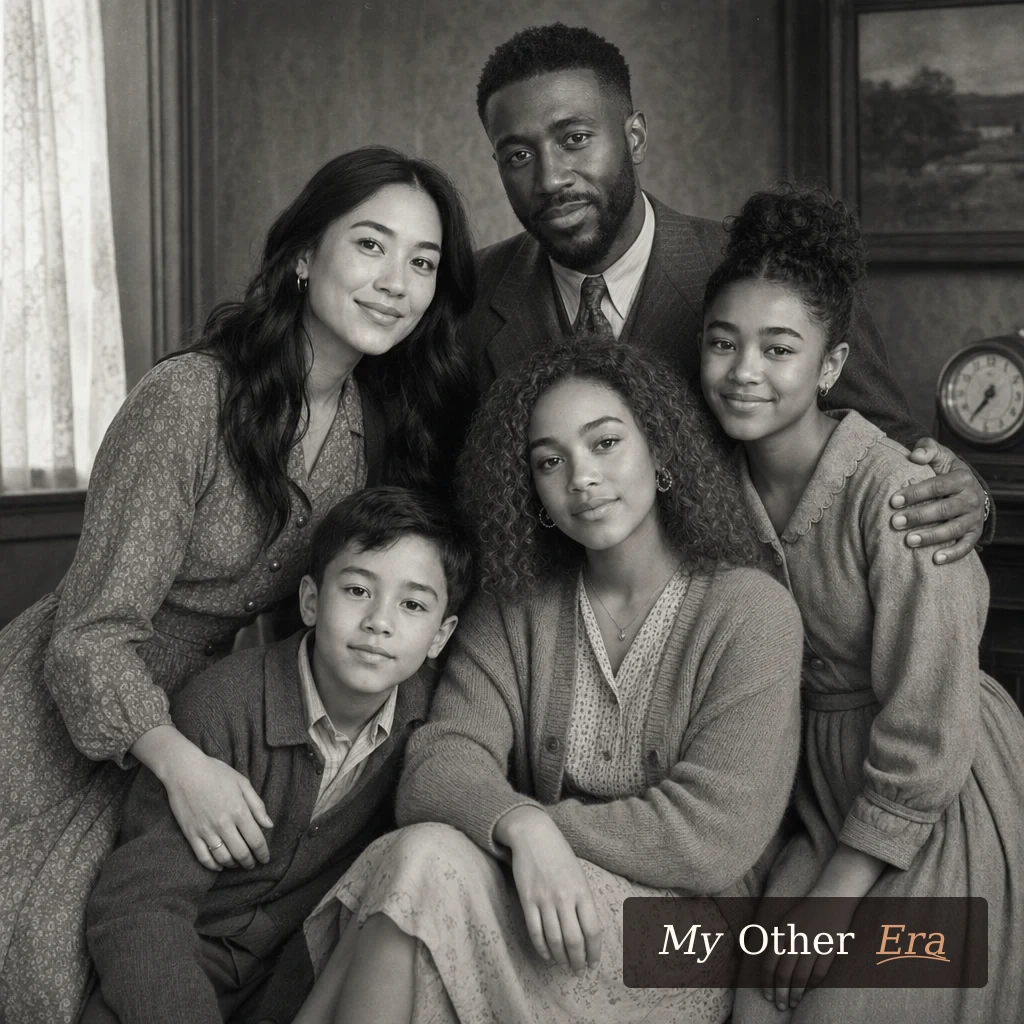
My Other Era’s Depression treatment takes cues from neat tailoring, modest studio light, softly waved hair, and the quieter portrait language associated with interwar family photographs. It does not depict poverty, certify a documentary scene, or assert that a person lived through the Depression.
A well-lit original photo with a simple crop helps the treatment retain a calm, period-informed composition. If the original photograph documents hardship or a named event, preserve its caption and provenance rather than replacing them with an invented narrative.
Related reading
Continue with the 1940s: wartime life and photography, or compare the visual shift directly in 1920s versus 1930s style.
A creative era portrait can honour the mood of a family story, but it is not evidence. For historical claims, link to the archive or collection record that supports them.
Try the studio
Try a 1930s-inspired portrait
The style evokes interwar portrait conventions; it does not claim to recreate hardship or a documented historical scene.
Open the studioRelated reading
Sources and further reading
AI-assisted draft, fact-checked against the sources below and reviewed by the My Other Era editorial team. No individual reviewer is named because no individual reviewer is being claimed.