Reading room / Article
1950s Family Portrait Ideas and Styling
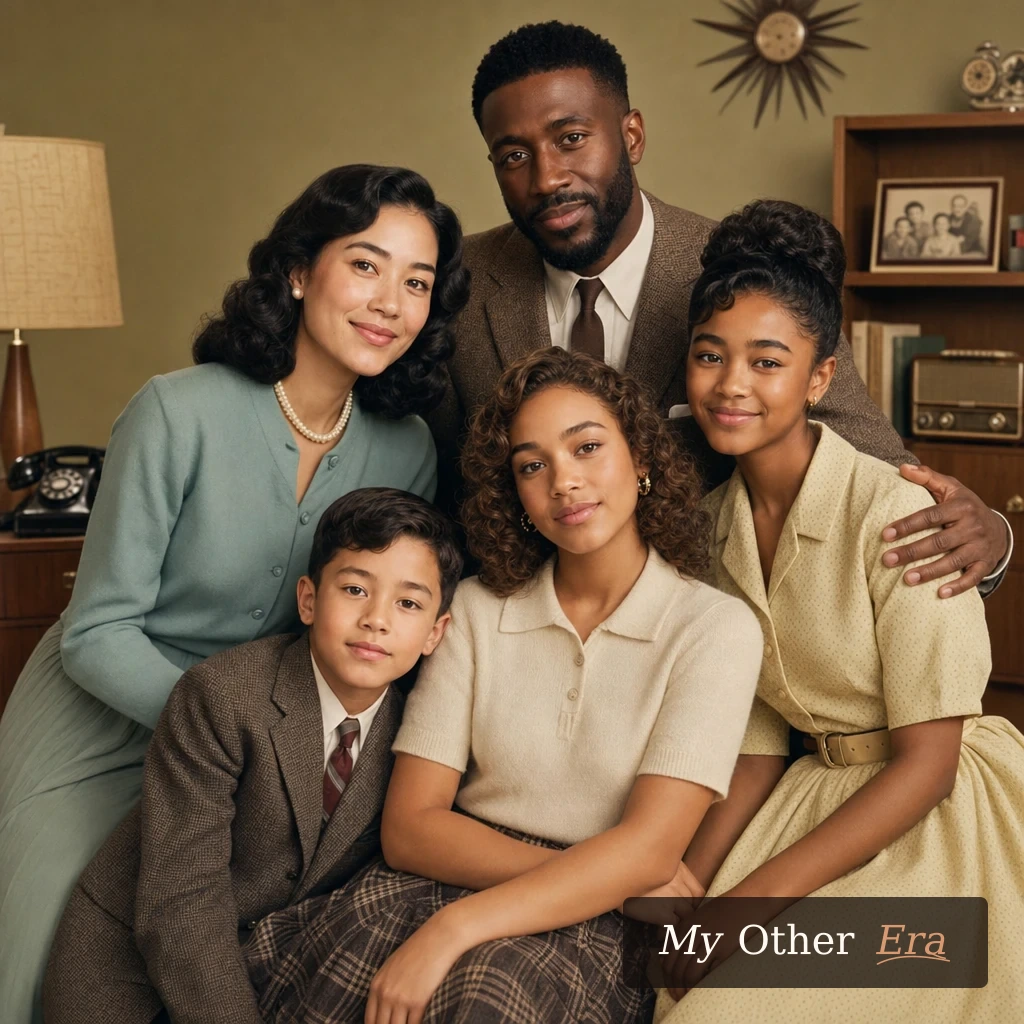
The best 1950s family portrait idea is one that lets the family look like itself. The decade’s polished advertising images, suburban interiors, workwear, school photographs, and formal studio records do not describe one universal household. Start with the relationship you want the picture to show, then use a limited wardrobe palette, a stable arrangement, and a few period cues to support it.
Choose a family scene, not a stereotype
Decide what the portrait records: a birthday, a new baby, a reunion, an everyday living-room moment, or a formal family photograph. A 1950s studio portrait and a backyard snapshot have different posture, lighting, and clothing. Region, race, class, migration, disability, and family structure also shaped domestic life; an image does not need a mid-century suburban set to read as 1950s.
Make a short brief that includes place and occasion. “1955 formal family studio, modest tailoring, warm neutral backdrop” is more useful than “1950s family.” If you are transforming an existing group photograph, keep the number of people, relationships, and relative ages explicit. A historical treatment should not silently add, remove, or swap a family member.
Coordinate color without making uniforms
Use a shared tonal range—navy and cream, muted red with warm neutrals, or soft greens and browns—while varying collars, textures, and levels of formality. Mid-century clothing can include tailored suits and shirtwaist dresses, cardigans, skirts, trousers, work shirts, children’s play clothes, and many garments that would not appear in a magazine spread. Let each person have a silhouette suited to their age and activity.
Small details carry the date when the group is viewed at a distance: a clean shirt collar, a narrow tie, a cardigan, a full skirt, a simple patterned blouse, a neat hair shape, or a modest accessory. Do not put everyone in a matching circle skirt or add hats indoors merely to announce the decade. A family portrait feels more credible when one person is slightly less formal.
- Pick two main colors and one quiet accent; repeat tones, not identical outfits.
- Vary texture so faces do not sit beside six equally busy prints.
- Keep logos, modern text, and invented uniforms out of the background.
- If one person is in a statement print, simplify the clothing around them.
Arrange the group around relationships
Arrange by connection and comfort rather than by height alone. Seated adults can anchor the frame while children stand or sit near the person they naturally approach. Use a chair, sofa, porch step, or table as a real structural aid, not a prop every person must touch. Bring faces onto a few visual levels and leave space around hair and shoulders so the group remains legible.
For a group transformation, give the studio a clear instruction: preserve all people, preserve their order and approximate pose, keep expressions natural, and change only the requested wardrobe, setting, or tonal treatment. Review hands and overlaps carefully. Group images are more vulnerable to identity drift than single-subject portraits, and an attractive result is not successful if it no longer represents the family.
Set the light and room to support the story
A formal portrait benefits from even, soft light and a calm background. A domestic scene can use a window, a shaded porch, or a single practical lamp as a visual reason for the light. Keep the light direction consistent across faces. A kitchen, station wagon, television, or modern open-plan room can date the image, but props should be secondary to the people and should never imply a specific family history you do not know.
For a studio interpretation, warm ivory walls, wood, patterned wallpaper, or a restrained floral can suggest the period without pretending to reproduce a particular home. Avoid turning the entire frame sepia: color existed in the 1950s, and black-and-white or tinted treatments were choices tied to medium, occasion, and access.
A useful family portrait plan
Prepare a primary group frame and two smaller variations: a formal full group, a closer crop of the adults and children, and a relaxed interaction such as a shared glance or hand on a shoulder. If the image will be made from one existing photo, select an original photo where everyone’s face is unobstructed and the crop includes enough of the clothing to make a change believable.
- Confirm consent before transforming or sharing a family photograph.
- Name the year range and setting so “1950s” does not become a generic retro filter.
- Preserve people, placement, and recognizable features in the brief.
- Check faces, fingers, garment closures, repeated patterns, and background text.
- Caption the final image as inspired by the era when its historical details are interpretive.
Try the studio
Create a 1950s portrait
The studio can apply a polished-1950s direction to a photo you have permission to use. It will preserve the people as carefully as the process allows, while the wardrobe and setting remain an artistic interpretation rather than an archival family record.
Open the studioRelated reading
Sources and further reading
- The Metropolitan Museum of Art, “The 1950s” — Collection-based context for postwar design, clothing, and visual culture.
- Smithsonian National Museum of American History, “Culture and the Arts” — Museum collections place domestic objects, clothing, and popular culture in material context.
AI assisted with the first outline and copy-editing suggestions. My Other Era reviewed the history, removed unsupported claims, and is responsible for the final editorial text.