Reading room / Article
1960s Mod vs 1970s Bohemian Style
“Mod” and “bohemian” are useful portrait directions, but they are not names for two complete decades. Mod developed especially through 1960s youth culture and London fashion while related modernist styles traveled internationally. Bohemian style in the 1970s drew on overlapping countercultural, craft, music, and vintage influences. People mixed these references, and many communities were left out of the fashion press that later defined the look. Use the comparison below as a visual decision tool, not a rigid historical test.
The fastest distinction: graphic versus tactile
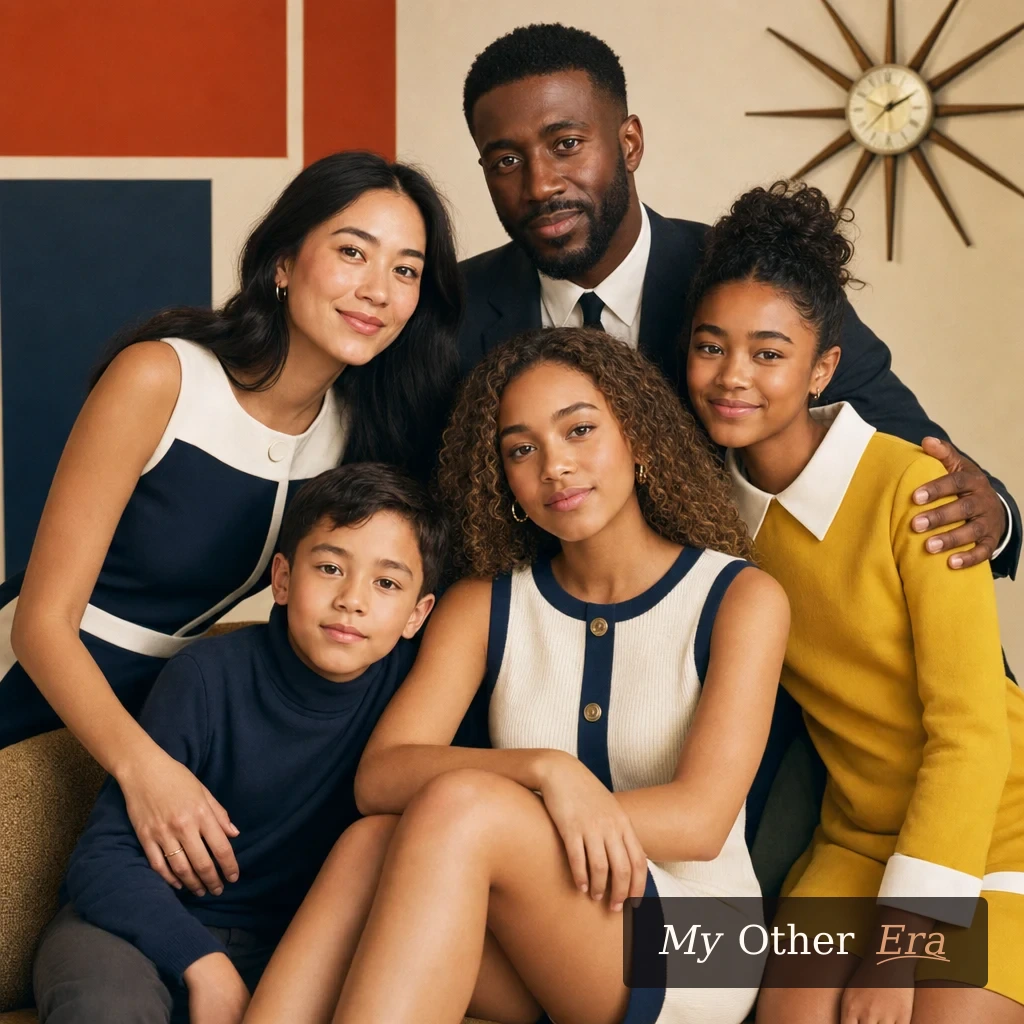
A mod portrait usually reads through a crisp graphic system: short or geometric shapes, clean blocks of color, sharp boots or shoes, and a background with strong lines. A bohemian portrait usually reads through tactile layering: flowing or flared shapes, natural-looking textures, embroidery or pattern, relaxed hair, and a setting that feels lived-in or outdoors. These are tendencies, not requirements.
If the image is becoming a costume board, remove one cue. A simple shift dress with an angular crop may say more than a miniskirt, go-go boot, checkerboard, and scooter all at once. Similarly, a textured blouse, denim, and warm daylight may establish a 1970s direction without turning the subject into a festival stereotype.
- Mod: line, contrast, precision, graphic crop.
- Bohemian: layer, texture, movement, informal environment.
- Shared ground: youth culture, vintage mixing, music scenes, and individual styling.
- Neither direction automatically describes every person in the 1960s or 1970s.
Clothing and hair cues that survive a portrait crop
For mod, prioritize the neckline, shoulder line, hem shape, and a single high-contrast color relationship. A cropped image may not show a full miniskirt, so a square collar, patterned tights, simple geometric earrings, or a clean bob can do more work. Men’s mod styling can use a narrow, tailored line, knitwear, or a deliberate color block; it is not limited to one suit.
For bohemian, prioritize the material and the way the garment falls: a peasant-style blouse, suede-like layer, denim, knit, flared trouser, or long skirt can create movement. Hair may be loose, waved, braided, or naturally textured. Do not treat one “free-spirited” hair type as authentic; keep the sitter’s hair and cultural identity central.
If the photograph is head-and-shoulders, choose one visible cue and let the face lead. If it is full-length, use the relationship between garment and ground—boot, trouser flare, hem, and stance—to distinguish the directions.
Color, location, and prop choices
Mod works well with black and white plus one saturated red, orange, blue, or green; cream and a bold pattern can be just as effective. Use a wall, tiled surface, stair, or hard-edged shadow for structure. Bohemian styling can use ochre, rust, olive, denim, cream, and muted plum, with wood, plants, fabric, or natural light supplying texture. These palettes are design suggestions, not claims about what everyone owned.
A record player, magazine, guitar, craft object, or vehicle may anchor a scene, but a prop should belong to the person’s story. Do not invent a political affiliation, musical career, or travel history from a visual style. A portrait can evoke a cultural moment without assigning a biography.
Pose and lighting: make the direction legible
Choose a contained, angular pose for mod: shoulders square to a wall, a clean seated line, or a direct gaze with one sharp gesture. Use a hard-edged shadow or even studio light, depending on whether you want graphic drama or catalog clarity. For bohemian, allow a shoulder turn, a seated floor pose, a hand in the hair, or movement in a scarf or sleeve. Warm window light and uneven texture support the relaxed direction, but avoid blur that loses the eyes.
A hybrid can be historically plausible because real wardrobes overlap. Keep one dominant system: mod clothing with a tactile outdoor setting, or bohemian layers with a strong geometric crop. Tell the viewer which idea leads rather than asking six symbols to compete.
A two-question choice test
Ask: “Would I recognize the intended direction if the prop disappeared?” and “Does the person still look like themselves?” If the answer to either is no, simplify the styling. When using an AI portrait, specify a bounded decade, the dominant silhouette, the light, and the elements to preserve. Avoid “1960s/1970s retro” unless you deliberately want a blend.
- Pick mod for a crisp, graphic, tailored or geometric reading.
- Pick bohemian for layered texture, movement, and a relaxed setting.
- Use the 1960s or 1970s era choice to keep the transformation from drifting across decades.
- Describe the result as inspired by a style current, not as a universal historical portrait.
Try the studio
Create a 1960s portrait
Try the mod-60s studio direction when you want a crisp graphic portrait from an original photo. If your reference is layered, earthy, and more relaxed, explore the bohemian-70s option instead. Both are selective interpretations, not complete pictures of their decades.
Open the studioRelated reading
Sources and further reading
- Victoria and Albert Museum, 1960s fashion collection — Museum objects that place 1960s silhouettes and youth-fashion references in context.
- The Metropolitan Museum of Art, “1970s Fashion” — Collection-based context for the decade’s varied fashion influences.
AI assisted with the first outline and copy-editing suggestions. My Other Era reviewed the history, removed unsupported claims, and is responsible for the final editorial text.