Reading room / Article
Victorian Era Explained: Society, Fashion, and Portraits
The Victorian era usually means the reign of Queen Victoria, 1837–1901, but it was not one unchanging look. Industrial Britain, its empire, and connected communities abroad changed dramatically across those decades. This guide separates the period's history from the polished, nineteenth-century-inspired portrait style available in My Other Era.
Dates, geography, and context
In the strictest sense, Victorian names the United Kingdom during Victoria's reign, from 20 June 1837 to 22 January 1901. Victorian influence also travelled through trade, migration, colonial rule, and popular culture; it should not be treated as a synonym for every country or for all of the nineteenth century.
Railways, factories, expanding cities, public education, mass newspapers, and new consumer goods reshaped daily life. Opportunity and wealth were distributed unequally. Class, gender, race, disability, religion, and location affected work, housing, movement, and access to the leisure represented in studio portraits.
Clothing and hair were social signals
As the V&A’s 1890s fashion history illustrates for the period’s final decade, women’s dress changed substantially over time: large sleeves and crinolines in the mid-century, increasingly shaped bustles in the 1870s and 1880s, and a longer, leaner silhouette by the 1890s. Men commonly wore tailored jackets, waistcoats, trousers, and hats, but working clothes, uniforms, children’s clothes, and regional dress could look very different.
Hair was often arranged rather than left loose. Women wore centre parts, pinned-up buns, braids, fringe, and sometimes hairpieces; men’s hair and facial hair varied by decade and occupation. A bonnet, collar, jewellery, ribbon, or watch could communicate respectability, age, profession, or wealth, but no single accessory identifies every Victorian sitter.
Victorian photography and the portrait studio
The period saw photography move from rare, technically demanding exposures to a commercial studio practice available to a much wider public. Daguerreotypes, ambrotypes, tintypes, wet-plate collodion prints, carte de visite portraits, cabinet cards, and later dry plates each produced different objects and visual conventions.
Long exposures encouraged stillness, and retouching, painted backdrops, props, and carefully controlled light shaped the finished image. A formal pose is therefore evidence of photographic technology and studio etiquette as much as personality. It is risky to infer a sitter’s exact class or character from posture alone.
How to read the era without flattening it
A portrait can be Victorian in date yet not be British, wealthy, or urban. Compare clothing with the photograph’s format, paper, mount, studio imprint, family records, and local history. A late-century fashion plate cannot stand in for the lived clothing of a factory worker, a rural family, or a colonised community.
For research, begin with museum collections and archives rather than costume shorthand. The V&A’s fashion holdings and the Library of Congress photographic collections show both the range of surviving objects and the limits of any one representative image.
My Other Era’s portrait interpretation
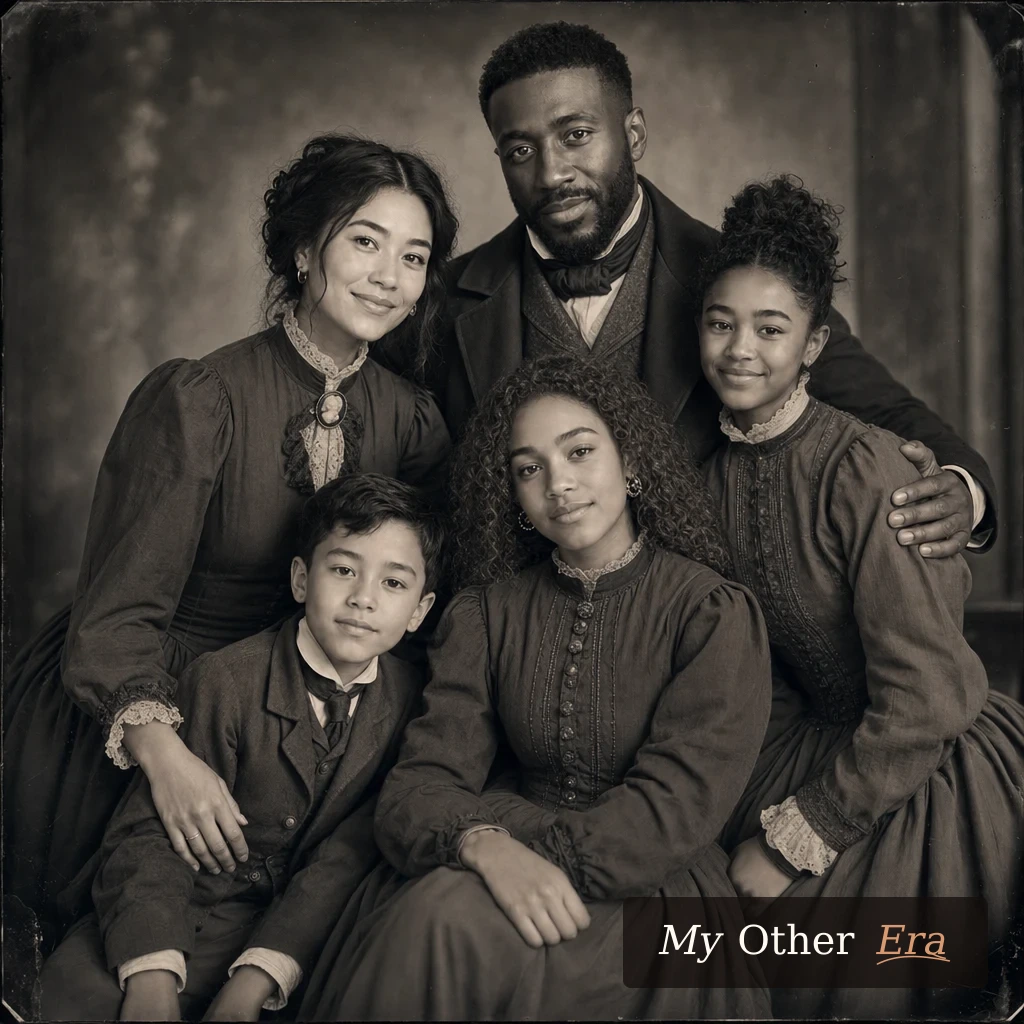
In My Other Era, the Victorian option is a creative interpretation inspired by nineteenth-century studio conventions: composed framing, restrained backgrounds, period-influenced tailoring, and a formal mood. It is not a claim that an output is an authentic historical photograph, or that it reproduces a specific person’s clothing or social position.
The result depends on the original photo and the selected treatment. Keep the original photo, describe the result as an AI-generated interpretation, and avoid using a stylised portrait as evidence for what every Victorian person looked like.
What to try in a portrait
A clear, front-facing or three-quarter original photo with visible shoulders gives the treatment useful structure. A simple neckline and uncluttered background leave room for an era-informed collar, jacket, hairstyle, or studio setting; these are creative choices, not historical reconstruction.
For a more personal story, pair the output with the person’s actual name, place, and date only when those details are known. The contrast between documented biography and imaginative styling is more honest—and often more interesting—than an invented backstory.
Try the studio
Try a Victorian-inspired portrait
Selects My Other Era’s Victorian treatment; it does not change or overwrite an active studio project.
Open the studioRelated reading
Sources and further reading
AI-assisted draft, fact-checked against the sources below and reviewed by the My Other Era editorial team. No individual reviewer is named because no individual reviewer is being claimed.