Reading room / Article
Edwardian Era Explained: Elegance and Changing Times
Edwardian commonly describes Britain during Edward VII’s reign, 1901–1910, and the years around it up to the First World War. The period’s graceful lines and formal imagery are real visual references, but they coexist with labour activism, imperial power, women’s suffrage campaigns, and unequal everyday lives.
A short period with a wide reach
Edward VII reigned from 1901 to 1910. Historians and museums sometimes use Edwardian more broadly for the years before the First World War, roughly 1901–1914. The label is primarily British; fashions were exchanged internationally and adapted to local materials, climates, economies, and customs.
Cities grew, mass transport and department stores changed shopping, and print culture made trends circulate quickly. At the same time, class divisions, colonial rule, domestic service, unsafe work, and restricted political rights shaped life. The well-dressed garden-party image is only one slice of the period.
Silhouette, clothing, and hair
Women’s fashion around 1900 often used the S-bend silhouette, created by a curved bodice and a skirt that fell from the hips. Tailored suits, shirtwaists, hats, lace, and decorated evening clothes were all in circulation. Corsetry and restrictive dress were not universal, and working, sporting, maternity, and regional clothing followed different practical needs.
Men’s lounge suits, morning dress, dinner jackets, uniforms, and hats varied with time, setting, and income. Women’s hair was frequently swept up into a soft pompadour or structured arrangement under a wide hat, while shorter practical cuts gained ground later. These are tendencies, not a dress code for every sitter.
Photography at the threshold of modernity
Dry-plate processes and more portable cameras made photography easier than it had been in the early Victorian decades. Studios still offered painted backdrops, controlled lighting, retouching, and formal posing, while amateur snapshots increasingly recorded holidays, streets, and family life.
A glass negative, postcard, cabinet card, or snapshot can supply useful clues, but image format alone cannot provide a precise date. Look for mounts, photographer addresses, clothing details, buildings, handwriting, and family records together. Early colour processes existed, yet most surviving family portraits from the period are monochrome.
The social context behind the polish
The Edwardian years included campaigns for women’s suffrage, debates about social welfare, organised labour, new leisure cultures, and anxieties about class and national power. The period also sits inside the history of empire, so a British imperial image should not be presented as a neutral global norm.
A portrait’s apparent refinement may reflect studio conventions and the sitter’s desire for a special occasion, not an ordinary day. Compare a formal commissioned image with photographs of work, sport, family, and public protest to avoid confusing aspirational presentation with universal experience.
My Other Era’s interpretation
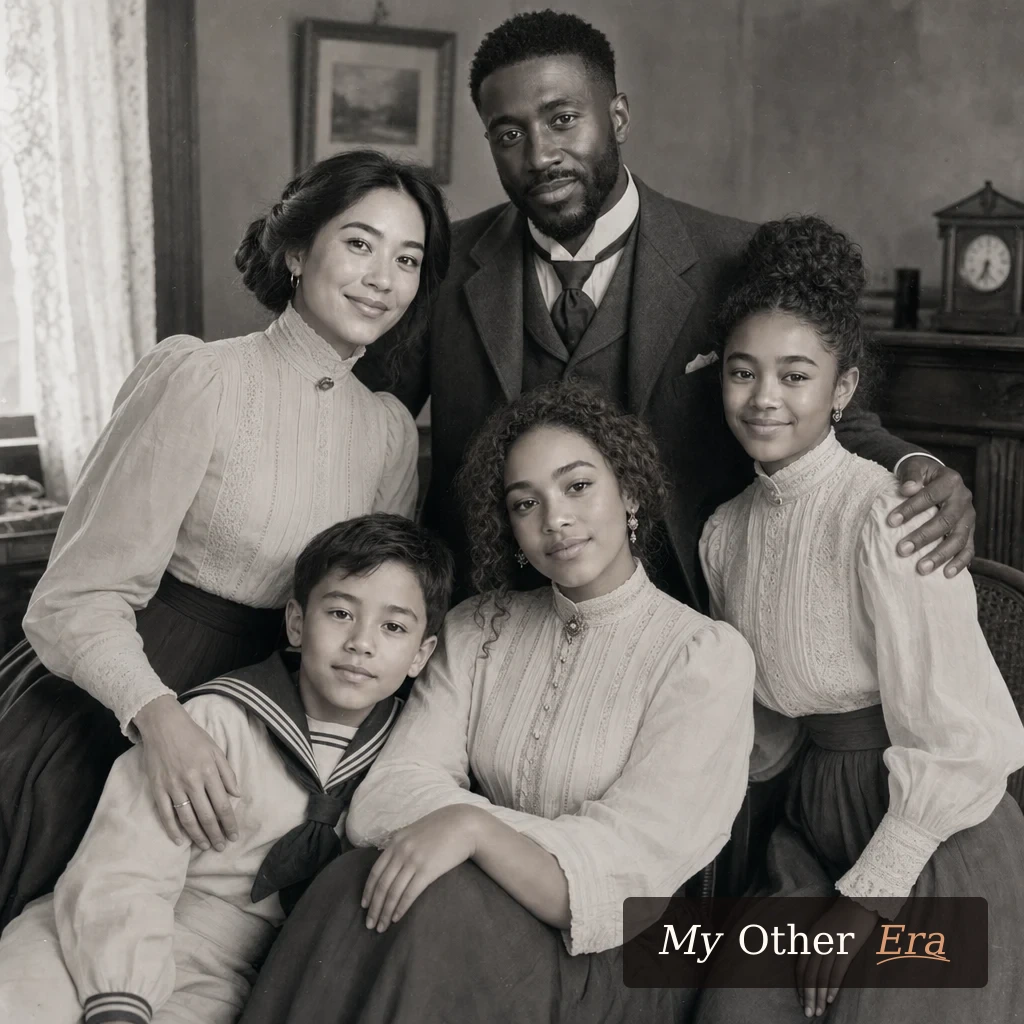
My Other Era’s Edwardian treatment borrows the period’s tailored polish, hat-and-collar vocabulary, soft studio light, and transitional mood. It compresses a complicated international period into an accessible visual option; it does not identify a real garment, recreate a documented studio, or certify that a photograph is from 1901–1914.
Because the treatment is generated from a contemporary original photo, modern details may remain or be transformed unpredictably. Treat the result as a respectful creative portrait, keep its AI label, and use archival evidence separately when dating a family photograph.
A useful starting photograph
Choose an image with a visible face, shoulders, and hairline. Three-quarter framing can support a period-inspired jacket or blouse while leaving enough room for the portrait’s composition. A neutral background helps the treatment suggest a studio without confusing a modern room for an Edwardian interior.
If you are comparing this style with Victorian dress, read our guide to Victorian versus Edwardian fashion and remember that borders between decades are porous.
Try the studio
Try an Edwardian-inspired portrait
This is an Edwardian-inspired portrait treatment, not an archival authentication service.
Open the studioRelated reading
Sources and further reading
AI-assisted draft, fact-checked against the sources below and reviewed by the My Other Era editorial team. No individual reviewer is named because no individual reviewer is being claimed.