Reading room / Article
The 1910s Explained: Fashion and Portraits in Transition
The 1910s are best understood as a decade split by the First World War, not as one costume. The pre-war years retained Edwardian formality while wartime work, mourning, shortages, and changing public roles accelerated practical change. Here is the context behind those shifts and the way My Other Era interprets them.
Dates, places, and a decade divided
The 1910s run from 1910 through 1919, but the First World War (1914–1918) is the central dividing experience in Europe and its global theatres. The United States entered the war in 1917; communities across Africa, Asia, the Middle East, the Americas, and Oceania were affected through empire, recruitment, supply, displacement, and trade.
Urbanisation, cinema, motor transport, telephones, department stores, and mass-circulation newspapers were changing life before 1914. War then altered work, family separation, mourning, rationing, and public space. Neutral countries and regions outside the main fronts had different experiences, so geography matters.
Clothing and hair through the transition
Early in the decade, women’s clothes could retain high waists, long skirts, large hats, and tailored or softly draped shapes. During the war, simplified skirts, practical separates, knitwear, uniforms, and shorter or easier hair arrangements became more visible, although fashion did not change overnight and class determined access to new clothing.
Men’s civilian tailoring continued alongside military uniforms, workwear, and sportswear. Women’s wartime jobs did not erase gender inequality, and the end of the war did not produce one instant modern wardrobe. Look for local regulations, fabric availability, occupation, age, and occasion before assigning a date from clothing alone.
Portraits, snapshots, and wartime evidence
Studio portraits, postcards, press photographs, albums, and small personal cameras all circulated. The postcard portrait and the snapshot made it easier to send an image to an absent relative, while formal military and family portraits carried emotional and administrative importance.
Photographs can document uniforms, badges, mourning, workplaces, and family networks, but captions and archives are essential. A soft focus or sepia tone is not proof that an image was made in the 1910s: later reproductions can imitate the appearance of earlier photographs.
Everyday life was not a single wartime story
Women’s paid work expanded in some sectors, soldiers and civilians lived with loss, and state propaganda shaped public images. Yet race, colonial status, class, age, disability, and gender determined who could enter those roles and how they were represented. A European middle-class fashion image cannot stand for the decade worldwide.
The best historical reading combines the photograph with letters, newspapers, census or service records, object labels, and provenance. Collections at the Imperial War Museums and Library of Congress offer useful examples while also reminding us that surviving images are selective.
My Other Era’s 1910s interpretation
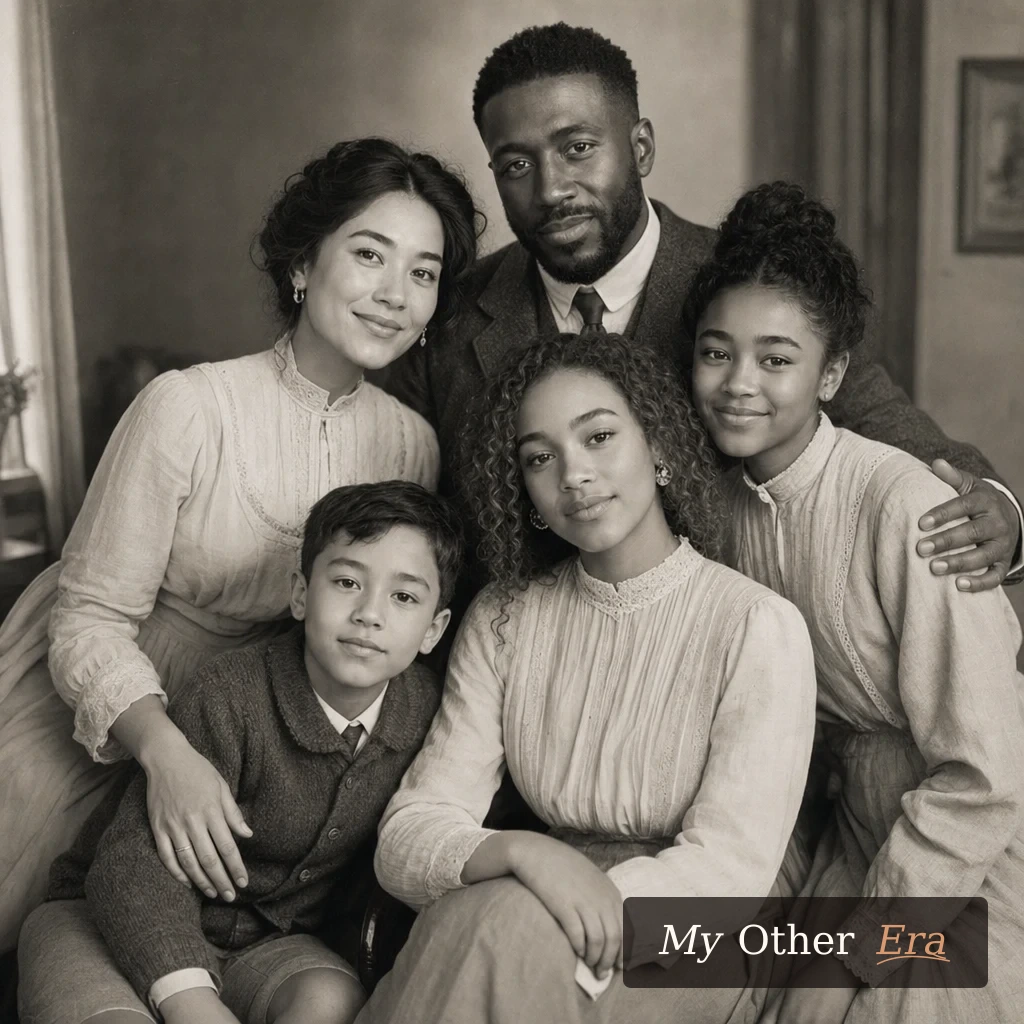
The 1910s option is a deliberately broad transition style: structured tailoring, restrained studio composition, and a visual hint of early modernity. It is not a claim that the output depicts wartime service, a particular country, or a historically documented person.
For a more pre-war feeling, use a formal, softly lit original photo. For a later-decade feeling, a straightforward crop and practical styling may read better. Either way, label the result as an AI-generated portrait interpretation rather than an original 1910s photograph.
Links for the next step
Read Edwardian elegance and changing times for the pre-war context, or continue to the 1920s and Art Deco to see what changed after the armistice. These are neighbouring editorial guides, not hard boundaries.
When dating an old photograph, preserve the back, mount, studio imprint, and family notes. A generated interpretation can help tell a story, but it cannot replace that evidence.
Try the studio
Try a 1910s-inspired portrait
This choice maps to a broad transition aesthetic, not a specific wartime location or event.
Open the studioRelated reading
Sources and further reading
AI-assisted draft, fact-checked against the sources below and reviewed by the My Other Era editorial team. No individual reviewer is named because no individual reviewer is being claimed.