Reading room / Article
What AI Historical Portraits Can and Cannot Recreate
An AI historical portrait can translate the visual language of a period onto a personal photograph, but it cannot travel back in time or recover facts that an original photo does not contain. It is most useful as a creative interpretation: a way to explore clothing, light, setting, and photographic mood while keeping a real person at the centre. Knowing the boundary makes the result more enjoyable and more honestly labelled.
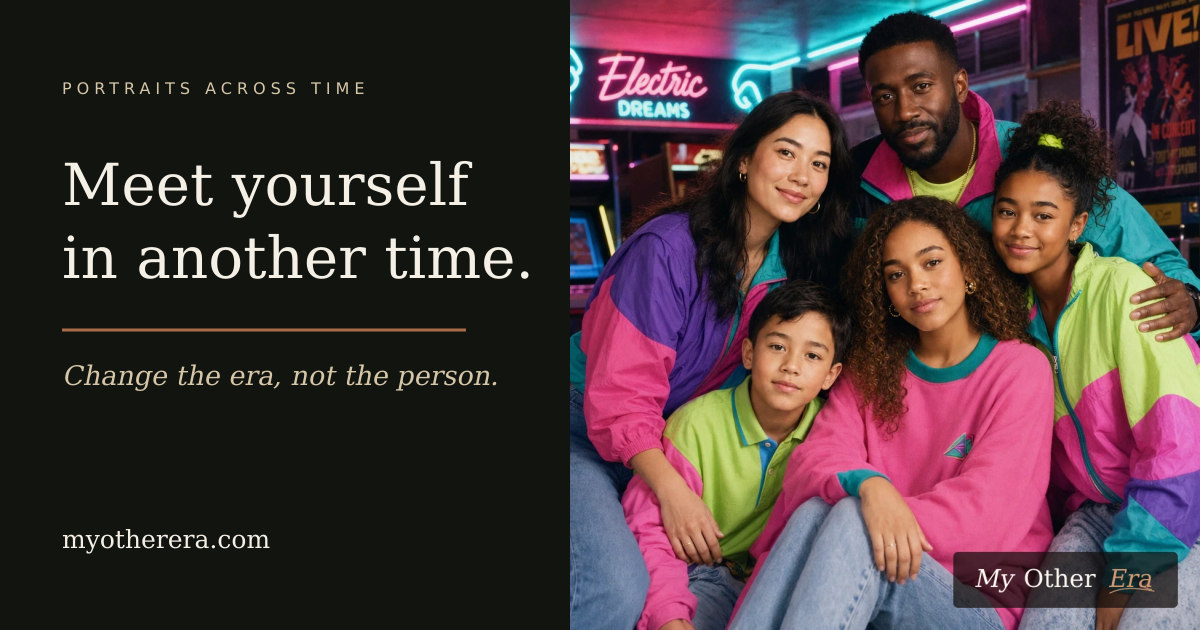
What an era portrait can do well
A well-chosen original photo gives the studio a starting point for the subjects' arrangement, expression, and broad visual identity. An era direction can then suggest a different silhouette, hairstyle, environment, lighting pattern, and image finish. These changes can make a modern photograph feel connected to a recognisable portrait tradition without claiming to reproduce one particular historical object.
The strongest use is comparative and creative. You can see how the same people might read in a formal Victorian-inspired composition, a 1950s family studio setting, or an early-digital 2000s snapshot. Each version is a visual hypothesis, not a recovered biography.
- Translate broad styling cues such as silhouette, backdrop, light, and photographic finish.
- Preserve the original photo’s composition when faces and spacing are clear enough to guide it.
- Offer a starting point for discussing how portrait conventions change across eras.
What it cannot establish
A generated image cannot prove what a person wore, where they lived, or what a real historical camera recorded. It does not know a family story that is absent from the original photo, and it should not be presented as an archival photograph. Even when the style looks convincing, visual plausibility is not historical evidence.
It also cannot guarantee a perfect copy of a face or object. Hands, small jewellery, eyeglasses, patterned textiles, text, and partly hidden people are especially vulnerable to invention or alteration. A result may be attractive while still being wrong in details that matter to the person depicted.
Likeness is guided, not guaranteed
Likeness depends on the original photo, visibility, pose, number of people, and the interpretation requested. A single well-lit face is a simpler case than a low-resolution group photograph with overlapping heads. Compare the output with the original at a normal viewing size and look for the features that make the person recognisable, rather than judging only the outfit.
If a result changes a meaningful feature, try a clearer original photo or a quieter direction instead of adding increasingly specific instructions. More detail in a prompt cannot recreate a hidden eye or restore an expression that was never captured.
Historical style is not historical accuracy
Period clothing and photography varied by region, class, age, occupation, occasion, and access to technology. A studio's era label necessarily compresses a broad history into a usable creative direction. It may evoke a period's visual cues, but it is not a museum reconstruction or a claim that every detail is correct for a particular year and place.
For a historically specific project, consult primary sources and specialist collections, then work with a historian, costume professional, or archivist as appropriate. Use an AI interpretation to explore ideas, not to replace that research.
How to review a result responsibly
A simple caption such as “AI-generated portrait inspired by 1930s studio photography, based on a 2026 original photo” tells viewers what they are seeing without making the image sound like an archival object.
- Label it as AI-generated or AI-assisted and describe the era as inspiration, not provenance.
- Compare faces, count people, and check the arrangement against the original photo.
- Treat invented accessories, text, insignia, and uniforms as unreliable unless independently verified.
- Do not infer a person's identity, health, class, nationality, or historical experience from the styling.
- Keep the original photograph and any relevant permission records separate from the generated image.
Where My Other Era fits
My Other Era provides supported era directions for experimenting with personal photographs. It does not turn a generated portrait into proof of a past event, guarantee an exact likeness, or substitute for preservation and historical research. The useful question is whether the interpretation gives you a thoughtful new way to look at your original photo—not whether it can be mistaken for a genuine photograph from the period.
Frequently asked questions
Can an AI portrait prove that clothing is historically accurate?
No. It can produce a plausible period-inspired combination, but plausibility is not proof. Date, region, class, occasion, and individual access all affect clothing, so specific claims need independent sources.
Why did the face or hands change?
The original photo may not provide enough visible detail, or the requested composition may require the portrait process to infer concealed features. Clearer, less obstructed photos and simpler compositions can reduce uncertainty, but no workflow guarantees perfect preservation.
How should I label a generated historical portrait?
Say that it is AI-generated or AI-assisted and identify the original photo and the era as inspiration. Do not call it an original, recovered, or authentic period photograph.
Is this a restoration tool for an old photograph?
No. A historical portrait interpretation and a faithful restoration have different goals. Preserve and scan an old photograph first, and use specialist restoration methods when recovering its original information matters.
Try the studio
Try an era-inspired portrait
Use the studio for a clearly labelled, era-inspired experiment. Keep the original beside the result and decide which visual changes feel useful rather than assuming they are factual.
Open the studioRelated reading
Sources and further reading
- National Institute of Standards and Technology: AI Risk Management Framework — A reference for thinking about limitations, uncertainty, and responsible use of AI systems.
- Library of Congress: Photography and the Archive — A named primary-source collection whose catalogue records demonstrate why photographs need provenance and context.
AI tools assisted with an early draft and copy editing. The My Other Era editorial team reviewed the text, checked the linked references, and remains responsible for the published version.