Reading room / Article
Victorian Portrait Clothing, Hairstyles, and Accessories
A convincing Victorian portrait starts with a readable silhouette, not a pile of antique-looking props. “Victorian” covers the reign of Queen Victoria (1837–1901), several countries and colonies, changing technology, and sharply different wardrobes by class, occupation, age, and decade. Use this guide to make a portrait that signals the period while leaving room for an individual person. It is a styling brief, not a claim that one outfit represents everyone who lived in the nineteenth century.
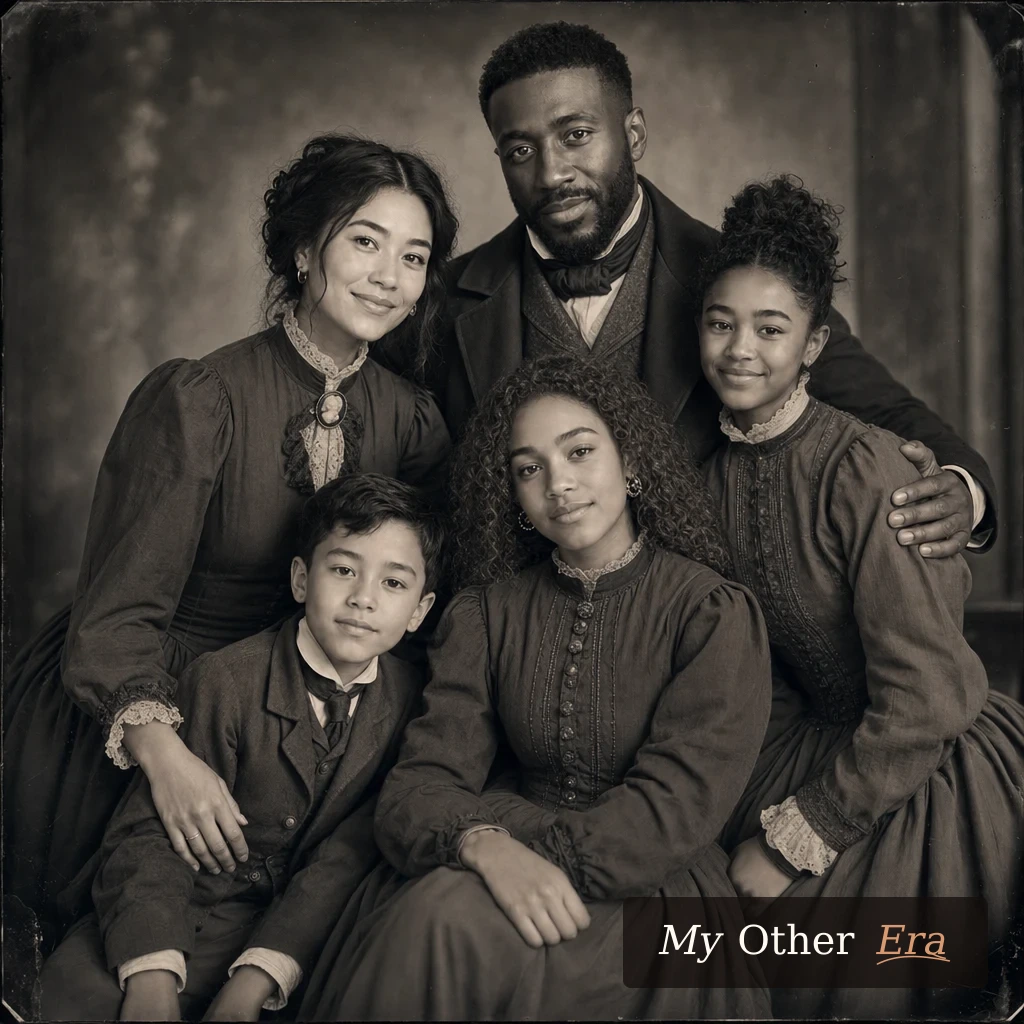
Start with a decade and a social setting
Choose a narrow direction before choosing lace or jewelry. An 1840s day dress has a different shoulder and skirt relationship from an 1870s bustle or an 1890s tailored suit. Decide whether the scene is a studio sitting, a town outing, a professional portrait, or a family record. A middle-class sitter in a formal photograph may wear their best clothing, so the result can look more polished than their everyday workwear.
Place matters too. British and North American fashion magazines circulated widely, but local textiles, climate, migration, and access to ready-made clothing changed what people actually wore. Avoid calling a generic dark dress “the Victorian look.” Instead, write down three anchors such as “1880s urban afternoon, middle-class, formal studio” or “1890s working professional, practical wool, outdoor light.” That brief will keep details from competing with the face.
- Silhouette: choose the shoulder, waist, and skirt or trouser volume first.
- Material: choose one or two believable textures, such as wool, cotton, silk, or velvet, rather than adding every period fabric.
- Setting: let the background support the social situation instead of using an ornate interior by default.
- Finish: add one era-specific accessory only after the clothing reads clearly.
Build the clothing from the outline inward
The V&A’s 1890s fashion history uses dated objects to document the period’s final decade. Across the wider Victorian era, the outline changed from wide mid-century skirts to the backward emphasis of the bustle in the 1870s and 1880s and a more columnar or tailored impression in the 1890s. A high neckline and long sleeves can suggest formality, but neither is a universal rule. A portrait can use a blouse and skirt, a day dress, an evening dress, or a tailored jacket depending on the sitter and occasion.
For men, a frock coat, lounge suit, waistcoat, shirt collar, or work jacket tells a different story. Facial hair, hat shape, and tie placement help, but they should follow the chosen date. Children’s clothing also had its own conventions and was affected by age and family means; do not put a miniature adult evening suit on every child. If styling a group, vary texture and collar height so the people remain distinct.
If you are adapting clothing already in a photograph, prioritize the collar, shoulder line, and visible front closure. Those areas survive cropping better than a hem or shoe. A simple, coherent alteration is usually more convincing than asking an image tool to invent intricate embroidery that the original photo never supports.
- Keep the face, hands, and posture as the visual focus; busy trim can become noise.
- Use matte textures for a sober daytime portrait and a restrained sheen for evening or ceremonial dress.
- Do not imply a corset, bustle, or restrictive garment is visible when the portrait cannot show it.
- For a contemporary person, treat the historical reference as an interpretation rather than an authenticity guarantee.
Hair and headwear: choose shape before decoration
Hair changes are often more legible than tiny clothing details. Think in broad shapes: center parts and controlled volume in earlier decades, the elaborate updos and hair ornaments associated with later nineteenth-century fashion, and the large hat silhouettes that became important in outdoor dress. A studio portrait may show a sitter without a hat; headwear should serve the setting rather than be a compulsory period marker.
Hair texture, protective practices, cultural identity, and available time matter. Do not treat Eurocentric fashion plates as a complete account of how every Victorian sitter wore their hair. For textured hair or a cultural hairstyle, retain the person’s identity and use period-appropriate framing, clothing, or accessories elsewhere. In an AI portrait, keeping the original hairline and recognizable features is often more respectful than forcing a historically fashionable style.
Accessories that explain the sitter
A watch chain, brooch, gloves, parasol, fan, hat, spectacles, book, or work-related object can make the scene specific. It can also turn into visual shorthand if used without thought. Ask what the object says about the occasion and the person. A pocket watch suggests a different story when worn with a formal waistcoat than when held as a prop. A book does not automatically make a sitter scholarly.
Use one primary accessory and one quiet supporting detail. Check scale: an oversized brooch may pull attention away from the eyes, while a tiny chain may disappear in a half-length crop. Avoid invented family crests, medals, uniforms, or occupational credentials unless the original photo and your brief support them.
A portrait-ready styling checklist
Before generating or photographing, review the portrait at the crop you expect to use. The best Victorian reference may be a three-quarter crop where the collar, shoulder, hands, and one accessory remain visible. For an AI transformation, describe the intended decade, setting, class context, clothing silhouette, lighting, and what must remain unchanged. That is more useful than a string of adjectives such as “old-fashioned, elegant, vintage.”
- Name the decade or a bounded range, not only “Victorian.”
- State the occasion and region when they matter to the image.
- Specify the visible silhouette and fabric; leave hidden construction unspecified.
- Request natural skin, recognizable features, and period styling without claiming a museum-authenticated reconstruction.
- Review jewelry, hands, buttons, and text for invented details before sharing the result.
Try the studio
Create a Victorian portrait
Bring a clear portrait to the studio if you want to explore this reading of the Victorian period. The result is an artistic era interpretation, not proof of what the sitter—or every Victorian person—would have worn.
Open the studioRelated reading
Sources and further reading
- The Metropolitan Museum of Art, “The Victorian Era” — A museum overview of nineteenth-century art, design, and historical context.
- Victoria and Albert Museum, “Victorian fashion history: 1890s” — A museum article using dated objects to explain late-nineteenth-century clothing and accessories.
AI assisted with the first outline and copy-editing suggestions. My Other Era reviewed the history, removed unsupported claims, and is responsible for the final editorial text.