Reading room / Article
1920s Portrait Poses, Lighting, and Composition
A 1920s portrait is not made by adding a gold fan and calling the lighting “Art Deco.” The decade included studio conventions, home cameras, publicity images, formal family records, and experimental modernist photography. This guide focuses on the visual decisions that survive in a finished portrait: a pose with a clear line, a light pattern that models the face, and a crop that gives geometry room to breathe.
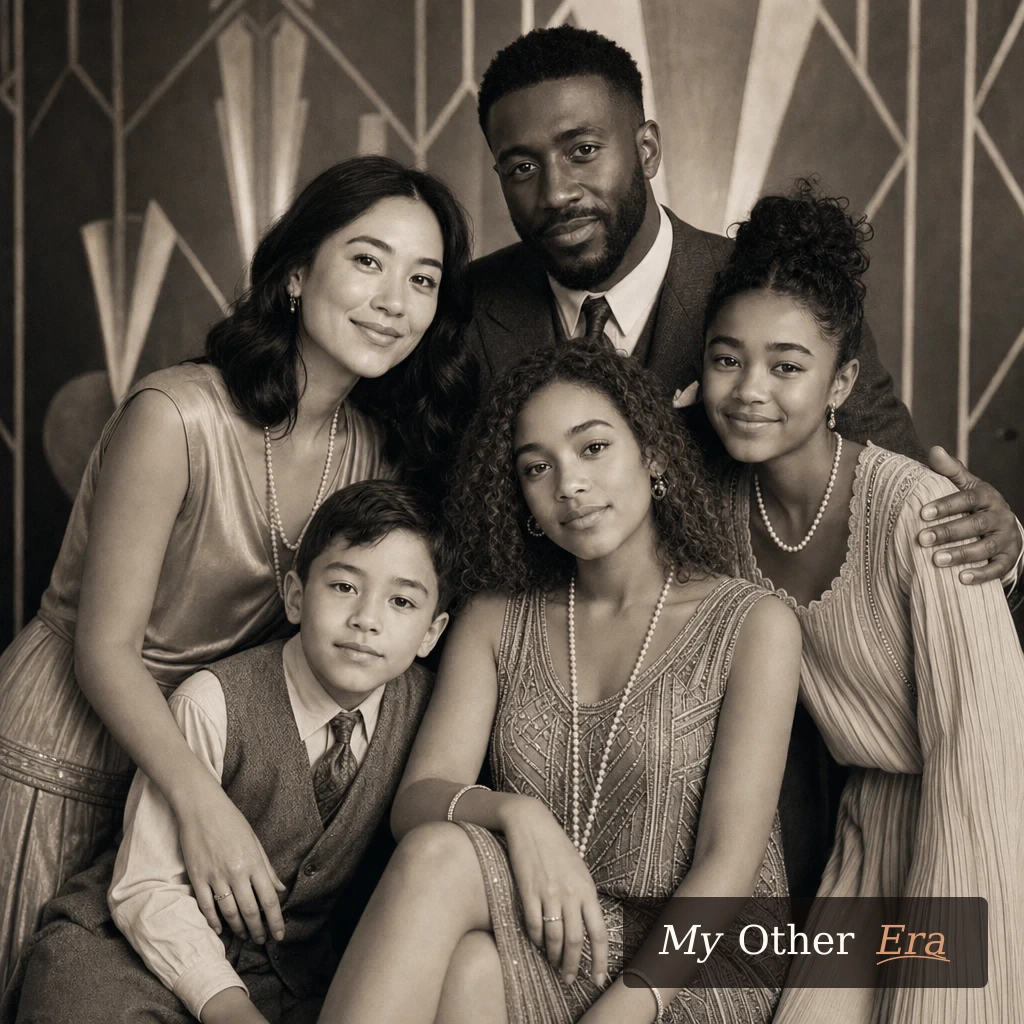
Pick the kind of 1920s picture you mean
The glamorous nightclub image is only one slice of the 1920s. A formal studio portrait, a fashion publicity image, a family group, and a candid holiday snapshot ask for different posture and lighting. Geography and access matter as well: the international Art Deco movement did not erase local dress, class differences, or the continuing use of older photographic conventions.
Write a one-line brief before posing: “1926 studio head-and-shoulders, graphic but quiet,” “late-1920s evening portrait with directional light,” or “family record with restrained geometric background.” If the brief says what kind of picture it is, the styling will feel intentional rather than like a collection of decade symbols.
Pose for a clean silhouette
Begin with the spine and shoulders. A seated three-quarter pose, one shoulder slightly nearer the camera, creates a strong diagonal without requiring theatrical movement. For a standing portrait, put weight into one leg and let the hands have a job: hold a clutch, rest lightly on a chair, or meet at the waist. Avoid stiff, symmetrical hands placed directly in front of the torso; they make the pose feel like a costume photograph.
For a group, use a shallow arrangement rather than stacking every face on one horizontal line. Give each person a distinct head angle and keep hands visible when possible. In a single-subject image, leave negative space toward the direction of the gaze. A cropped elbow or hat brim can become a deliberate graphic edge, but accidental tangencies between a prop and the head look messy.
The 1920s did not prescribe one universal body language. A restrained pose may be more appropriate for a family or professional record than a theatrical flapper gesture. Let age, relationship, clothing, and occasion determine the energy.
- For a head-and-shoulders crop: turn the torso slightly, then return the eyes to camera.
- For a seated portrait: keep knees and hands aligned with the intended crop so they do not disappear awkwardly.
- For a couple: offset the faces and vary the shoulder angles instead of mirroring both bodies.
- For a group: establish a center of attention without making every person perform the same expression.
Use light to describe planes, not just sparkle
Directional light helps a portrait read as photographic. A broad source placed to one side gives gentle modeling; a smaller or more distant source creates a harder edge and stronger shadow. A frontal source can flatten the face, which may suit a formal record, but it also removes the planes that make a geometric composition convincing. If working from a modern photo, describe the intended light direction rather than asking for an undefined “1920s glow.”
A restrained palette of warm ivory, charcoal, brass, and one saturated accent can support an Art Deco reference without turning the background into a pattern wall. Use a fan, screen, doorway, or stepped shape as a framing device only if it supports the crop. Shadows should have a plausible direction; multiple contradictory highlights are a common sign that an image has become decorative rather than photographic.
Historical photographs were made with different cameras, emulsions, lenses, and printing processes. A contemporary AI result may borrow their tonal vocabulary, but it does not recreate the original exposure or material. Describe it honestly as a 1920s-inspired portrait.
Compose with geometry and breathing room
Art Deco influence often appears through symmetry, stepped lines, fan shapes, circles, and controlled repetition. You do not need all of them. Select one geometric relationship—such as a centered arch behind an off-center sitter—and keep the face clear of high-contrast edges. Vertical architecture gives a formal feeling; a diagonal arm or spotlight gives movement.
Choose the final crop before adding details. Square or near-square framing can emphasize a centered studio arrangement, while a vertical crop gives a hat, shoulder line, or long necklace room. Keep enough background to show the shape you chose, but do not sacrifice eyes and hands merely to show a decorative set.
A practical shot list or AI brief
Make three versions rather than trying to force every mood into one frame: a quiet formal portrait, a directional-light three-quarter pose, and a looser crop with one geometric prop. When transforming an original photo, specify what is fixed (identity, expression, number of people, pose) and what can change (wardrobe, background, tonal treatment). Check the result for plausible hands, consistent light, and readable faces before selecting it.
- Pose: seated or standing, torso angle, hand placement, gaze direction.
- Light: broad or hard source, camera-left or camera-right, shadow density.
- Composition: crop, negative space, one geometric background shape.
- Finish: photographic texture and restrained contrast—not a promise of period-authentic film stock.
Try the studio
Create a 1920s portrait
Choose the Art Deco era in the studio to test a pose and composition that suit your own original photo. It is a creative interpretation of the period’s visual language, not a reconstruction of one historical photograph.
Open the studioRelated reading
Sources and further reading
- The Metropolitan Museum of Art, “Art Deco” — Context for the international design movement and its geometry.
- Library of Congress, Ansel Adams’s Manzanar photographs — A primary-source collection that illustrates how lighting, framing, and printing shape a photographic record.
AI assisted with the first outline and copy-editing suggestions. My Other Era reviewed the history, removed unsupported claims, and is responsible for the final editorial text.